Showing posts with label journalism. Show all posts
Showing posts with label journalism. Show all posts
6.28.2009
Journalism Basics: soon, soon
I've been absent from the Journalism Basics pieces. Promise I will resume this series soon. This week, even. I know you're all waiting!


6.11.2009
6.10.2009
Reporter's notebook

The object in the photo is a staple and icon of American journalism: a reporter's notebook. It's the last one I have from my days at the Seattle P-I and I have filled it up. Which means that another connection to my years in journalism has been broken (yeah, yeah, I can hear DylanW saying: "Cry me a river").
For years, until people starting recording interviews and taking notes on their laptops, the reporter's notebook was a standard item in the journalist's toolkit. It's 4 inches wide by 8 inches deep, spiral bound at the top, with lined note paper inside and a stiff cardboard backing.
Unless you have small hands, it's easy to hold and take notes on. It's particularly handy when you have to interview someone standing up, like at a fire or an accident. And it can be easily stuffed in a back pocket when you need your hands free.
I wasn't a reporter at the P-I, but I used the occasional reporter's notebook to take notes at meetings or for other work-related projects. This one followed me home. I've been using it in my new job, where I interview people all the time, and for the neighborhood web site I've been working on, Eastlake Ave, where I tend to be interviewing people and covering meetings.
My colleague at work, Sherry, and I are both refugees from the newspaper storm and we've asked to have some of these ordered for the office. I found some for our personal use yesterday at Staples. The brand name is "Evidence," which Sherry and I both thought was funny.
6.03.2009
Journalism basics (movie edition)
 Dustin Hoffman, left, as Carl Bernstein and Robert Redford, right,
as Bob Woodward in "All the President's Men."
And now, a short break from our Journalism Basics for a movie: "All the President's Men." In addition to being a terrific film and a great history lesson, this is an excellent primer on how journalists operate and the difficulties that await even the best of them.
"All the President's Men" (for the few who don't know) is the true story of Carl Bernstein and Bob Woodward, two junior reporters at the Washington Post who stumbled into the Watergate scandal and, despite their inexperience, proceeded to report the hell out of it and help bring down President Nixon in the process.
Few films have captured the job of the reporter better than this one. We're there for the glory moments when a big scoop falls into place and Woodward and Bernstein are riding high. We watch them go through the grunt work of reporting (the scene where they manually search thousands of index cards in the Library of Congress should quell any notion of a reporter's life being glamorous). And we see at least one moment when they make a big mistake and struggle to recover from it.
"Woodstein," as they came to be know at the Post, and their editors, including the legendary Ben Bradley, practically wrote the book on how to conduct an investigation like this: Always get things from two sources before publishing. Dig hard and dig everywhere. Don't be afraid to be a pest if it will further the story. Have no life other than the story. Be hungry and stay hungry. Follow the money.
 My favorite scene in the film occurs in the evening. Ben Bradley (played by Jason Robards, left,) stops by the newsroom on his way out for the evening. Woodward and Bernstein are excited and anxious about their latest story, confident that it will move their investigation forward.
Bradley takes their typewritten pages (no computers in 1973) and starts to read. And read. "You haven't got it," he finally says. They complain but he won't be budged. He takes out his red editing pen and starts to mark up their copy.
"Stick it inside someplace," he says to another editor. When Bernstein complains this is a "goddamn important story," Bradlee replies: "Get some harder information next time."
Perfect. And a lesson worth learning: Make sure you've really got the "harder information," not the soft stuff, before you publish.
Near the end of the film, Woodward and Bernstein go to Bradlee's house late at night. They made a big mistake in a story and they've been trying to figure out what went wrong. Turns out, a source misunderstood Bernstein's confirmation instructions. The story was right, but not for the reason they said.
They're exhausted and scared (Deep Throat has warned them their lives may be in danger), and they're wanting a break and, probably, a little sympathy. Bradlee isn't having it:
"You know the results of the latest Gallup Poll? Half the country never even heard of the word Watergate. Nobody gives a shit. You guys are probably pretty tired, right? Well, you should be. Go on home, get a nice hot bath. Rest up ... 15 minutes. Then get your asses back in gear. We're under a lot of pressure, you know, and you put us there. Nothing's riding on this except the, uh, first amendment to the Constitution, freedom of the press, and maybe the future of the country. Not that any of that matters, but if you guys fuck up again, I'm going to get mad. Goodnight."Terrific stuff. That's what journalism is all about. Go and watch it. The book is worth reading, too.
Also, check out Woodward's book on Mark Felt, the FBI official who was his secret source, Deep Throat.
6.01.2009
Journalism basics, part 3 (in which I quote Tennesse Williams)
 Blanche (Vivien Leigh) and Stanley (Marlon Brando)
in the film version of "A Streetcar Named Desire."
"I have always depended on the kindness of strangers."
What does Blanche's easy virtue have to do with journalism?
It means that journalists are always depending on others to help us get our stories. People tell us things. They give us documents. They guide us when we are lost ("Follow the money," Deep Throat famously told Bob Woodward during the Watergate investigation). They invite us to events. They consent to sit for interviews and they take our phone calls. They answer our questions.
And it means that, unlike Blanche, we should always be questioning their motives (this is a corollary to our last installment: If your mother says she loves you, check it out). Why is that person calling to give you a scoop? Why didn't he or she call your competitor? Are they giving you the story because they like you or because they think you're more likely to be easily deceived?
Does the person calling you have a vested interest in the story? What is it? How might it be clouding their motives? Is he or she giving you those documents simply because they like you and they want to see justice done? Or are they trying to get even with someone? Or, maybe, draw attention away from something even more important?
What's the real story here?
While many reporters are skeptical and always dig and ask hard questions, others aren't so tough minded. They happily take a story lead without asking "why me?" And, sometimes, they get used.
Another reason not to depend too closely on the kindness of strangers: If someone offers you money or merchandise or a free trip somewhere, just say no. It's best to stay pure and not even have the appearance of a conflict of interest.
Next installment: Pay no attention to that man behind the curtain.
5.30.2009
Journalism basics, part 2
This is the second of my occasional series of journalism basics for online news folks. Today's lesson:
IF YOUR MOTHER SAYS SHE LOVES YOU, CHECK IT OUT
This is an old saw and one that I've heard credited to Chicago newsies. What it means is: Don't trust what people tell you, even people you believe to be trustworthy. People lie, people get things wrong, people repeat untrue information and present it as fact, and people flat out don't know what they're talking about. Check out what they tell you.
What should you check out? Everything from the simple (please, spell names correctly) to the complex (is that "widely cited study" really accurate? Do those budget figures add up? Did the city councilor really say what you heard he/she said?). You'd be surprised how often things turn out not to be what they seem.
One example: Back in the 1980s, stories began circulating in the news media that reported shocking numbers of children going missing every year in the U.S. Reports placed the number at 1.5 million and up with 50,000 kids said to be abducted annually.
People panicked. Photos of missing children began appearing on milk cartons with the caption, "Have you seen me?" The kidnapping and murder of Adam Walsh became a national story and a TV movie.
Unfortunately, the numbers were wrong. Reporters Diana Griego and Louis Kilzer of the Denver Post looked into the story and found the numbers of missing and abducted kids were inflated. Very inflated (94 to 95 percent of the missing kids were later found).
Children's advocates had initially quoted the figures. Reporters then repeated the numbers without checking on their accuracy. Other reporters picked them up from those stories and repeated them again. Once the figures were cited in story after story they quickly became gospel and were re-reported as fact. And no one stopped to check them.
Finally, two reporters had the brains to ask a simple question: Is this correct? And it wasn't.
So, always question what you're told. Look for corroborating information. Check sources (and ask yourself if the source is truthful. Do they have an ax to grind?). Don't assume things to be correct. Make sure they are!
Next lesson: "I have always depended on the kindness of strangers."
IF YOUR MOTHER SAYS SHE LOVES YOU, CHECK IT OUT
This is an old saw and one that I've heard credited to Chicago newsies. What it means is: Don't trust what people tell you, even people you believe to be trustworthy. People lie, people get things wrong, people repeat untrue information and present it as fact, and people flat out don't know what they're talking about. Check out what they tell you.
What should you check out? Everything from the simple (please, spell names correctly) to the complex (is that "widely cited study" really accurate? Do those budget figures add up? Did the city councilor really say what you heard he/she said?). You'd be surprised how often things turn out not to be what they seem.
One example: Back in the 1980s, stories began circulating in the news media that reported shocking numbers of children going missing every year in the U.S. Reports placed the number at 1.5 million and up with 50,000 kids said to be abducted annually.
People panicked. Photos of missing children began appearing on milk cartons with the caption, "Have you seen me?" The kidnapping and murder of Adam Walsh became a national story and a TV movie.
Unfortunately, the numbers were wrong. Reporters Diana Griego and Louis Kilzer of the Denver Post looked into the story and found the numbers of missing and abducted kids were inflated. Very inflated (94 to 95 percent of the missing kids were later found).
Children's advocates had initially quoted the figures. Reporters then repeated the numbers without checking on their accuracy. Other reporters picked them up from those stories and repeated them again. Once the figures were cited in story after story they quickly became gospel and were re-reported as fact. And no one stopped to check them.
Finally, two reporters had the brains to ask a simple question: Is this correct? And it wasn't.
So, always question what you're told. Look for corroborating information. Check sources (and ask yourself if the source is truthful. Do they have an ax to grind?). Don't assume things to be correct. Make sure they are!
Next lesson: "I have always depended on the kindness of strangers."
5.29.2009
On the Media on Seattle's news scene
NPR's On the Media looks this week at the Seattle news scene after the demise of the print P-I. If you've followed the story closely, there isn't much new in their report, but it's mostly well done and worth listening to.
On the Media gives us some of the usual suspects: Eli Sanders of the Stranger offers his usual half-informed analysis (the P-I is a shadow of its former self ... gee, ya think?). Scott Gutierrez of seattlepi.com explains what's different about the P-I now that it's online only (fewer people, more emphasis on breaking news). David Boardman of the Seattle Times encourages people who love newspapers to keep subscribing (but he misses the point that it's the lack of advertising, not subscribers, that is causing big problems for papers).
Tracy Record of the West Seattle Blog offers the best analysis: The news blog she and her husband, Patrick, run is filling an important need (and they're covering stuff the dailies never did anyway), but what's missing are the journalists with the broader, city-wide view. She's encouraged that former P-I folks are willing to be "guns for hire" and offer their services to blogs like hers.
You can listen to the whole piece here:
On the Media gives us some of the usual suspects: Eli Sanders of the Stranger offers his usual half-informed analysis (the P-I is a shadow of its former self ... gee, ya think?). Scott Gutierrez of seattlepi.com explains what's different about the P-I now that it's online only (fewer people, more emphasis on breaking news). David Boardman of the Seattle Times encourages people who love newspapers to keep subscribing (but he misses the point that it's the lack of advertising, not subscribers, that is causing big problems for papers).
Tracy Record of the West Seattle Blog offers the best analysis: The news blog she and her husband, Patrick, run is filling an important need (and they're covering stuff the dailies never did anyway), but what's missing are the journalists with the broader, city-wide view. She's encouraged that former P-I folks are willing to be "guns for hire" and offer their services to blogs like hers.
You can listen to the whole piece here:
5.28.2009
Journalism basics (yes, they matter whether you print on paper or pixels)
I’ve been meaning for some months to write a post on a few basics of journalism that beat bloggers should know and which they ignore at their peril.
It’s easy to poke fun at older, mainstream journalists who, it may be thought, don’t understand the new online, digital world. But, those folks do know a few things, simple, practical tips that will make you a better journalist and might keep you from getting sued in the process.
Since I never seem to have time to write up the entire list as one post, I’ll be doing these one at a time, beginning with:
FIRST: DO NO HARM
Hippocrates is credited with coining that statement in the 4th century B.C. He meant it for physicians but it’s equally appropriate for journalists.
When you’re out doing your journalistic thing, try not to do harm. By which I mean hurting innocent people or publishing something that causes innocent people to be hurt or bungling your reporting so that the bad guys not only get away with whatever bad stuff they’re doing but actually gain public sympathy in the process and then go on to do more bad stuff.
In other words: Don’t leave the situation worse than you found it. Be aware that what you publish has repercussions. Make sure that what you’re publishing is not only accurate but is germane and important to the story. Just because you find out something about a person doesn’t mean that you have to publish that information. Is it relevant to the story or merely titillating? Will it cause harm to a person physically or unfairly or unnecessarily harm their reputation? Does the story require that this information be made public? If not, then don't publish it.
Don’t hide behind the excuse of “I was just telling people what I learned.” Sometimes, we uncover information that we don’t publish, much as we might like to, because it simply isn’t relevant to the story. It's tempting to show off how smart we are by publishing everything we find out. Don't give in to that temptation.
That doesn’t mean you cover up or suppress unpleasant information, but it does mean that what you do publish should be important enough to be publicly exposed.
It’s easy to poke fun at older, mainstream journalists who, it may be thought, don’t understand the new online, digital world. But, those folks do know a few things, simple, practical tips that will make you a better journalist and might keep you from getting sued in the process.
Since I never seem to have time to write up the entire list as one post, I’ll be doing these one at a time, beginning with:
FIRST: DO NO HARM
Hippocrates is credited with coining that statement in the 4th century B.C. He meant it for physicians but it’s equally appropriate for journalists.
When you’re out doing your journalistic thing, try not to do harm. By which I mean hurting innocent people or publishing something that causes innocent people to be hurt or bungling your reporting so that the bad guys not only get away with whatever bad stuff they’re doing but actually gain public sympathy in the process and then go on to do more bad stuff.
In other words: Don’t leave the situation worse than you found it. Be aware that what you publish has repercussions. Make sure that what you’re publishing is not only accurate but is germane and important to the story. Just because you find out something about a person doesn’t mean that you have to publish that information. Is it relevant to the story or merely titillating? Will it cause harm to a person physically or unfairly or unnecessarily harm their reputation? Does the story require that this information be made public? If not, then don't publish it.
Don’t hide behind the excuse of “I was just telling people what I learned.” Sometimes, we uncover information that we don’t publish, much as we might like to, because it simply isn’t relevant to the story. It's tempting to show off how smart we are by publishing everything we find out. Don't give in to that temptation.
That doesn’t mean you cover up or suppress unpleasant information, but it does mean that what you do publish should be important enough to be publicly exposed.
4.10.2009
No News is Bad News, Event 2
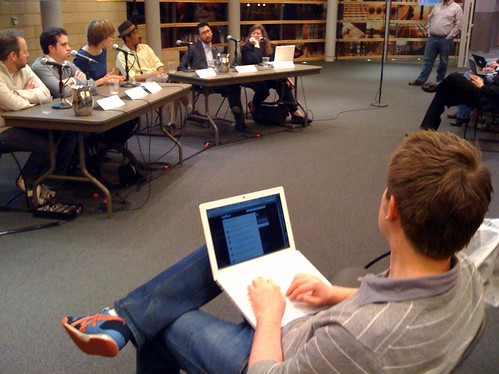
Josh live Tweets the No News is Bad News event #2.
The second No News is Bad News event ("Making It Work: Journalism and Our Flying Car Future") was Thursday evening at City Hall. This one focused on what models are working or show promise for online, post-newspaper journalism.
It was encouraging and exciting how many ideas came out of this meeting. There's no "magic bullet" fix for what ails the news biz, but there are many possibilities. And that's a good sign.
Here, in no particular order of importance, are a few thoughts:
- Making connections: Rita Hibbard (formerly of the Seattle P-I, now of InvestigateWest, a new still-forming news site) was talking about part of her group's business model: selling their work to other publications that might not be able to afford an investigative team. And Tracy Record of the West Seattle Blog, who was also on the panel, said: "We'd buy your stories." Bingo! Not only is it great to see these connections being made but it shows how journalists might finance their work, post-newspapers. Boutique sites will shop their product to other sites that would like the content but can't afford to produce it.
- Buried in the statistics: Moderator Cory Bergman (LostRemote and MyBallard) cited statistics from a recent study on newspapers and their popularity among the public. The stat that I found interesting was how people looking for information on new businesses don't turn to newspaper web sites for that info. They look elsewhere (Yellow Pages sites, Google, etc.). So, why should advertisers try to promote new businesses on a newspaper web site? If newspapers want a piece of that money, they need to get connected to their communities. You need to know what your community is interested in and offer that.
- Old tricks, new medium: Cory and Scott Durham (Instivate, Central District News) talked about things they are doing with advertisers (coupons, etc.) to show them how the community responds to their ads. Scott talked about providing hyper local coverage that wasn't available before. As I told several people, we did hyper-local years ago (and did some of those same things with ads) with the community weeklies I worked for here in Seattle. What's different is that the web is cheaper to publish on, faster and has more room for content. Scott raised a very good point: Hyper-local web sites are providing a place for small businesses to advertise and achieve good results. Many newspapers forgot those small businesses and priced ads out of their reach. The web puts them back in the game. And that's a good thing.
- If your mother says she loves you, check it out: Scott talked about how stories you wouldn't expect to be big sometimes take off. He cited a reader post on Central District News where someone complained about a local pizza place. The debate took off with the pizza shop owner joining in. Rita Hibbard made an interesting point: Her first thought in that situation would be: Who is this person doing the complaining? Is it a competitor trying to slam another business? And that's a good point to remember. One of the things journalists are supposed to do is be skeptical and check out things like that and find out what's really going on. There's a sense that the community will sort out issues like this online. I'll be interested to see how that works. How does the community detect and report a fraud? What are the liability issues in a situation like that? This issue also came up during a discussion of citizen journalists and trust. Scott, I believe, noted that trust will have to be built over a period of time. And that's no different than it has always been with journalism. You build trust with your audience by reporting accurately over time. Violate that trust with bad reporting or false information and your audience will (rightly) dump you.
- "Ricky and Lucy paid for Walter Cronkite:" I'm borrowing that quote from Art Thiel of nwsportspress.com, seattlepi.com and KIRO-AM. He made that point while the panel was discussing longer, investigative and narrative pieces. Those are costly to produce and can be hard to get people interested in reading. How to pay for them? Art's point was that that type of journalism really doesn't pay for itself. "I Love Lucy" paid for Edward R. Murrow and Walter Cronkite. How will online investigative reporters pay their own salaries? Mike Davidson of Newsvine, I believe, noted that we've never really paid for journalism. Journalism was the lure to get us to read/tune in for the stuff (advertising) that did pay the bills. The question for online news entrepreneurs: How do you find that revenue to pay for the journalism? Some people smirk at seattlepi.com's photo galleries, but those get people onto the site and bring in lots of hits and lots of ad dollars.
- New tricks, new medium: Robert Khoo of Penny Arcade (he has no journalism background, which is a big help when you're trying to envision new models) encouraged people to think of new ways to promote your brand and make money. One of Penny Arcade's big money makers is the annual PAX game show in Seattle. GlobalPost in Boston is offering a premium service called Passport where you'll get access to exclusive content and a chance to talk with reporters and editors and even suggest story ideas. News web sites need to think like that. Khoo also talked about establishing your brand and identity online. If your readers trust you, your viewpoint carries more weight. Recommend a product (or a news story) and they'll be interested because they value your opinion.
- Know the business side: Journalists have, for years, been told that the business side of the operation was not their problem. Indeed, we were told it was wrong to be interested in the business operations because that might taint our coverage. I think the main message of this event was that those days are over. At the least, journalists are going to have to have a business model and know how the bills are paid. Should you bend your coverage to suit advertisers? I wouldn't go down that route. Think "transparency." Tracy Record says that whenever West Seattle Blog mentions an advertiser in a story, they note that the business advertises with them. That informs the reader and alerts them to the potential of bias.
3.25.2009
Message received

Found this while cleaning out my desk at home. Hmmmm ...
Reminds me of the first managing editor I ever worked for, at the Prosser Record-Bulletin when I was in high school. When she interviewed me for the job (I started out cleaning floors) she said:
"If you're looking for fame or fortune, you're in the wrong place."
Wiser words hath never been spoken. But, it was a fun ride nonetheless.
Subscribe to:
Posts (Atom)
